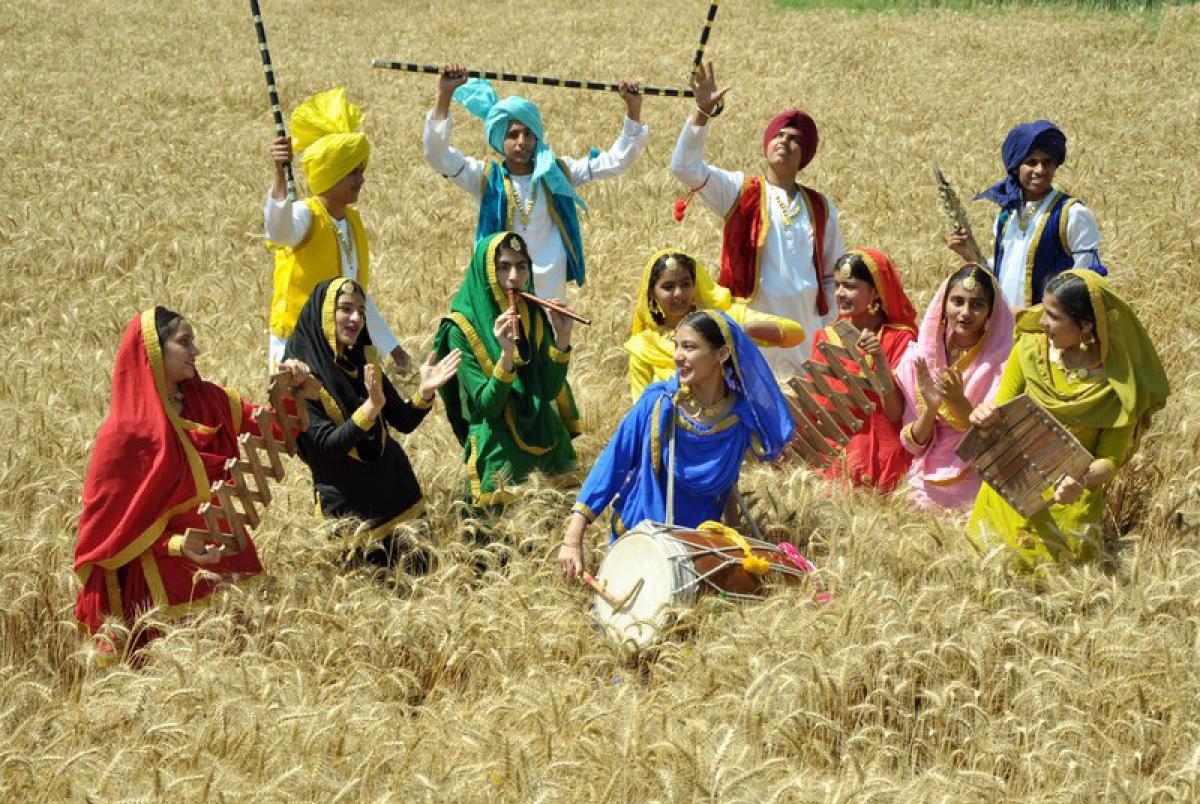
Every April, the wheat fields of Punjab turn gold. The winter crop, sown in October, has spent months drinking from the soil of the Majha, Doaba, and Malwa plains, and now it stands ready to harvest. At the same moment, something is happening in the sky: the sun is crossing the boundary into Mesha, the first sign of the zodiac. Bhārat has been watching this crossing for thousands of years, and it has never stopped celebrating it.
The Farmer’s Calendar


The moment when the sun enters Mesha rashi is called Mesha Sankranti, one of twelve solar transitions that the Hindu calendar marks through the year. This one is the most significant: it is the beginning of the solar year, the first day of spring’s full arrival, and for the farmers of Punjab, it is the day the harvest is in. The festival that marks this day in Punjab is Vaisakhi, named for the month of Vaisakha that follows.
Punjab is one of the most agriculturally productive regions in Bhārat, and the rhythm of the year has long been organized around two great crops. The winter wheat, called rabi, is sown in October when the rains end and harvested in April when the heat begins. Vaisakhi is its celebration, the moment when months of labor finally meet their reward. Families gather, neighbors visit each other’s fields, and the mood across the countryside is one of relief and joy.
The traditional way to express that joy is through bhangra, the exuberant folk dance of Punjab. Men leap and spin to the beat of the dhol drum, arms raised, bodies fully committed to the rhythm. Women perform giddha, a complementary form of folk dance marked by clapping and sung verses called boliyan. Fairs called melas spring up across Punjab, and people bathe in rivers and sacred tanks as a form of ritual renewal. The whole season hums with a sense of beginning.
One curious fact about Vaisakhi: it is tied to the sidereal solar calendar, which measures the sun’s position against the backdrop of fixed stars rather than the seasons. This means the date drifts very slowly forward relative to the Gregorian calendar. Today it falls on April 13 or 14, and will continue to drift into mid-April over the coming centuries.
The Founding of the Khalsa

On Vaisakhi of 1699, Guru Gobind Singh, the tenth Sikh Guru, stood before a vast assembly at Anandpur Sahib, a town nestled at the foot of the Shivalik hills in what is now Rupnagar district. Tens of thousands of Sikhs had gathered, as they did every year, to celebrate Vaisakhi with their Guru. What happened next transformed the festival into one of the most sacred days in the Sikh calendar.
Guru Gobind Singh emerged from his tent holding an unsheathed sword. He asked the assembly: who among you is willing to offer his head? The crowd fell silent. Then, one man stepped forward. The Guru led him into the tent. He emerged alone, the sword red. He asked again. Another man stepped forward. Then another, and another, and another. Five men in all, before the stunned assembly, had walked into that tent.
The Guru then brought all five men out together, alive, dressed in new clothes. The deaths had been a test, not an execution. These five men became the Panj Piare, the Five Beloved Ones: Daya Singh from Lahore, Dharam Singh from Hastinapur, Himmat Singh from Jagannath Puri, Mohkam Singh from Dwarka, and Sahib Singh from Bidar. They came from different castes and from five different corners of Bhārat. That was not an accident. The Guru was building something that would transcend every division of birth and region.
That something was the Khalsa, which means “the pure.” The Guru prepared amrit, a sacred nectar made from sugar water stirred with a double-edged sword called a khanda, and initiated the five men into this new community with its own distinct identity, discipline, and code of conduct. He then asked the five to initiate him in return, making himself equal to his own disciples in a gesture of remarkable humility.
Members of the Khalsa were given a new surname, Singh (lion) for men and Kaur (princess) for women, and they took on the Panj Kakkar, the five articles of faith that each begins with the letter K in Punjabi: Kes (uncut hair), Kangha (a wooden comb), Kara (a steel bracelet), Kachha (a cotton undergarment), and Kirpan (a steel sword). Each article carries layers of meaning. The kara, for instance, worn on the wrist, is a circle without beginning or end, a reminder of the infinite nature of the Divine.
The context matters. Guru Gobind Singh’s father, Guru Tegh Bahadur, the ninth Sikh Guru, had been publicly executed in Delhi in 1675 on the orders of the Mughal emperor Aurangzeb for refusing to convert to Islam. The founding of the Khalsa was a spiritual response to that era of persecution: the creation of a community with the courage, the identity, and the solidarity to stand firm against any force.
Today, Takht Sri Kesgarh Sahib, the gurdwara built at Anandpur Sahib on the site where the Khalsa was founded, is one of the five most sacred seats of Sikh authority. On Vaisakhi, hundreds of thousands of pilgrims make their way here. The air fills with kirtan, devotional singing, and the scene is one of the great human gatherings that Bhārat quietly produces every year without the world always noticing.
Amritsar: The Golden Temple and Its Shadow

In Amritsar, Vaisakhi begins before sunrise at Harmandir Sahib, the Golden Temple, the most sacred site in the Sikh world. The day opens with the continuous reading of the Guru Granth Sahib, the Sikh holy scripture, and one of the most visible rituals of the day is the changing of the Nishan Sahib, the triangular Sikh flag that flies above every gurdwara. The old flag is ceremonially lowered and replaced with a new one, a public act of renewal.
Then comes the nagar kirtan, the procession through the city. The Panj Piare walk at its head, dressed in blue and saffron, carrying the Sikh standard. Behind them come thousands of devotees singing shabad, sacred hymns, to the beat of drums. The procession moves slowly through the streets of Amritsar, and the sound of it fills the city for hours. Today, nagar kirtans take place wherever Sikhs have settled: in London, Toronto, Vancouver, and New York, the streets are closed and the hymns ring out just as they do in Punjab.
Central to the day, and to Sikh life more broadly, is the langar, the free community kitchen. Harmandir Sahib’s langar feeds between 50,000 and 100,000 people on an ordinary day. On Vaisakhi, that number swells far higher. The meal is vegetarian and open to absolutely everyone, without distinction of religion, caste, or background. This is seva, selfless service, one of the most deeply held values in the Sikh tradition, made manifest in the simple act of feeding strangers.
Vaisakhi in Amritsar also carries a shadow that cannot be set aside. On Vaisakhi day of 1919, British troops under General Reginald Dyer entered Jallianwala Bagh, a walled public garden a few hundred meters from the Golden Temple, where thousands had gathered to observe the festival. Without warning, Dyer ordered his soldiers to open fire. The British official death toll was 379. Indian estimates put the number at more than a thousand. The date and place were not coincidental: people had come to Amritsar precisely because it was Vaisakhi. Every year since, the celebration in Amritsar has been inseparable from that memory.
One Day, Many New Years
What few people outside Bhārat realize is that Vaisakhi is not celebrated only in Punjab. The same solar event, the sun crossing into Mesha, is recognized as a new year across much of the subcontinent, under different names and with different customs, but with the same underlying instinct.
In Tamil Nadu, the same day is Puthandu, the Tamil New Year. Families wake before dawn to arrange the kani, an auspicious display of rice, coconuts, betel leaves, flowers, gold, and money that is meant to be the first thing one’s eyes fall upon in the new year. The belief is that what you see first on this morning sets the tone for all the months ahead, so the arrangement is made with great care the night before.
In Kerala, the day is Vishu, and it too centers on a pre-dawn ritual of seeing. The vishukkani is arranged with golden konnappoo flowers (the Indian laburnum, which blooms precisely in April), a lit lamp, a mirror, raw rice, fruits, and vegetables. One by one, family members are led to it with their eyes closed, then allowed to look. The gifts that come with the day, called vishukkaineetam, are given by elders to children, and the mood is one of warmth and gentle ceremony.
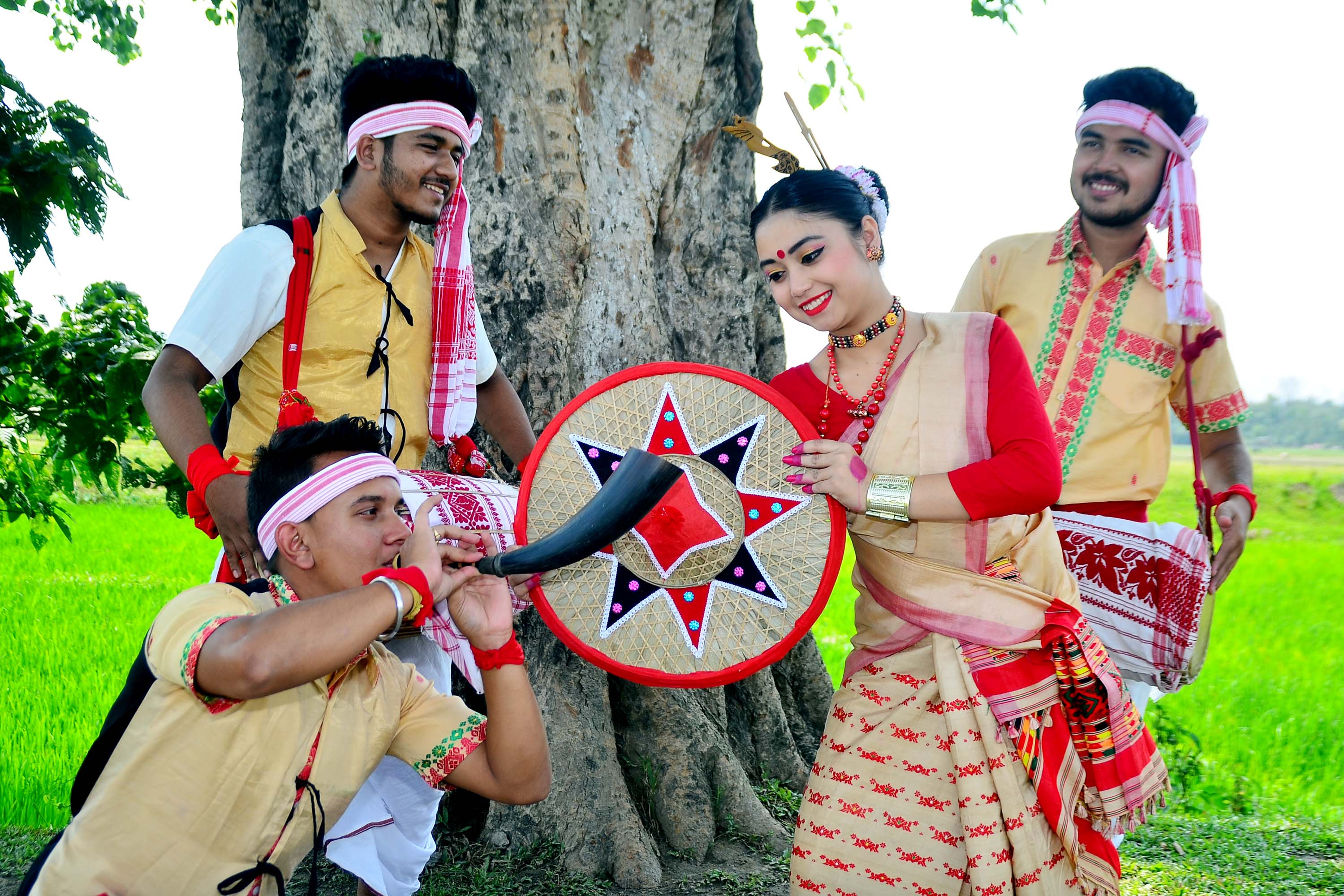
In Assam, the solar new year begins with Bohag Bihu, also called Rongali Bihu. It is a festival of spring and youth, full of energy. Young people in traditional silk mekhela sador perform the Bihu dance in open fields, the movements expressive and joyful, the drumming insistent. Cattle are washed, fed special foods, and honored for the labor they share with the farmer. The festival lasts for days, and its spirit is one of the most unambiguously celebratory in the Indian calendar.
In Bengal, the same solar crossing is Pohela Boishakh, the Bengali New Year. Dhaka and Kolkata fill with color, processions, new clothes, sweets, art exhibitions, and song. Rabindranath Tagore wrote songs specifically for this day, and they are still sung every year as part of the dawn celebrations, his words woven into the morning as naturally as birdsong.
Even where the exact date differs slightly, as with Ugadi in Andhra Pradesh and Karnataka or Gudi Padwa in Maharashtra, which follow the lunisolar calendar rather than the solar one, the spirit is the same: spring has arrived, the year has turned, and it is time to begin again.
There is something quietly remarkable about a single moment in the sky, the sun crossing an invisible line into Aries, being watched and celebrated by so many different peoples across this vast land for so many thousands of years. In Punjab it sounds like a dhol drum and looks like the Golden Temple burning gold in the early light. In Kerala it is a lamp flame caught in a mirror before the house has woken. In Assam it is young people dancing in fields still cool with morning. The names are different. The foods are different. The prayers are different. But the impulse underneath them all is the same: to notice the turning of the year, to be grateful for what the earth has given, and to step forward into what comes next.