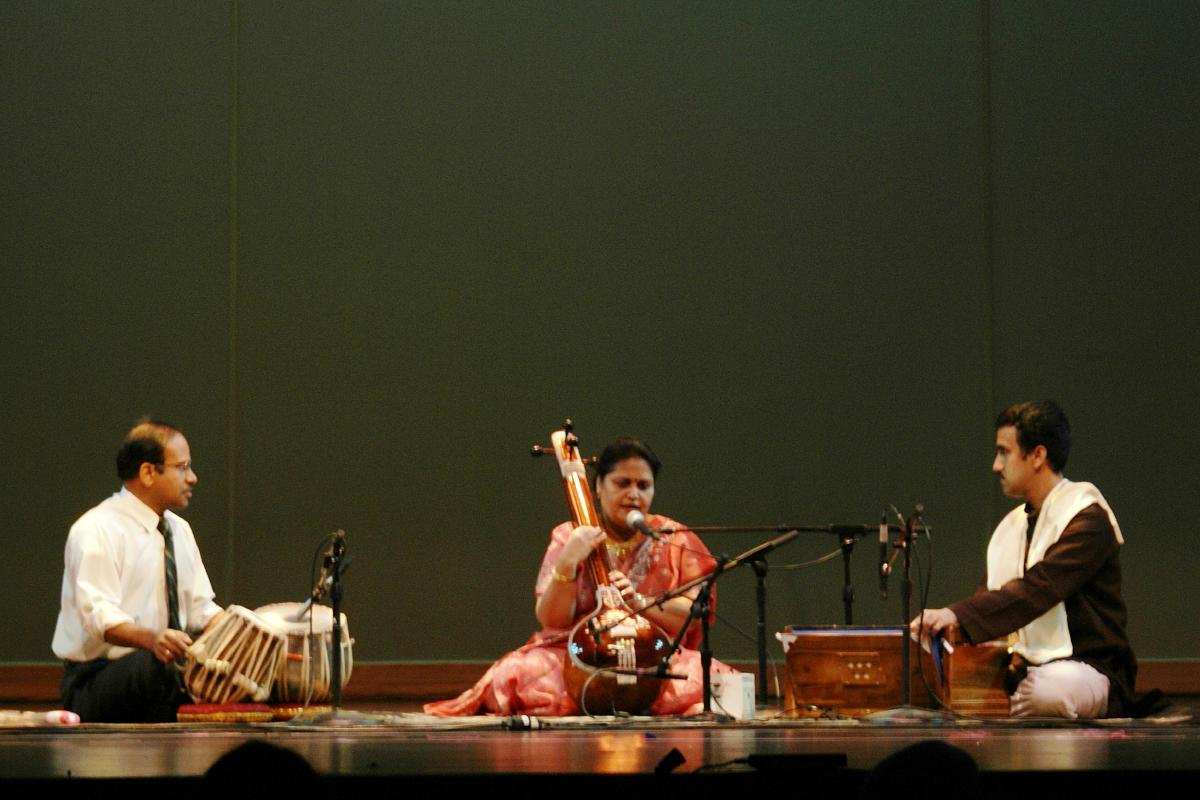
There is a raga in Indian classical music called Bhairavi that is almost always performed last, as a kind of farewell. Musicians say it carries the feeling of parting, of something beautiful drawing to a close. What Bhairavi reveals is something essential about classical music in Bhārat: every aspect of this tradition, from the choice of notes to the time of performance, is designed to speak to a specific part of human experience. This is music built not to entertain but to move, to illuminate, and sometimes, to say goodbye in the most beautiful way possible.
Roots in the Sacred
The classical music of Bhārat is among the oldest living musical traditions on earth, with roots stretching back more than three thousand years. The earliest foundation is the Sāmaveda, one of the four ancient Vedic texts, which was composed almost entirely in sung form. Unlike the other Vedas, which were primarily chanted or recited, the Sāmaveda was structured around melody. The hymns of the Rigveda were set to specific musical patterns, creating what may be the world’s earliest system of musical notation.
The tradition was given its first great theoretical text sometime between 200 BCE and 200 CE, when the sage Bharata Muni composed the Natyashastra. This vast Sanskrit work covers theatre, dance, and music in extraordinary detail, laying out the principles of melodic modes and rhythmic cycles that still underpin classical music today. A later text, the Sangita Ratnakara by Sarangadeva in the 13th century, went even further in systematising ragas and talas, and is still considered authoritative by both of Bhārat’s great classical traditions.


That music and the sacred were intertwined in ancient Bhārat was no accident. Sound itself, nāda, was considered a form of cosmic energy. The syllable Om was understood as the primordial vibration from which all existence arose. Music was not entertainment in the modern sense. It was a form of devotion, a means of approaching the divine, and learning it was a profound spiritual discipline. Many of the greatest classical compositions are addressed directly to specific deities, and the raga associated with a piece was chosen to create exactly the right emotional atmosphere for that act of devotion.
The Soul of Raga
The word rāga comes from the Sanskrit root meaning “to colour” or “to dye.” A raga colours the mind of the listener, painting a distinct emotional landscape through the choice of notes and the way they are approached and ornamented. But a raga is neither a scale nor a fixed melody. It is something more subtle: a framework of musical possibilities, with specific notes that must be emphasised, phrases that are characteristic, and a mood that must be evoked. Within that framework, a skilled musician improvises, following the logic of the raga while finding their own path through it.
One of the most remarkable aspects of the raga system is its connection to time and season. Certain ragas are meant to be played at dawn, others at midnight, others in the burning heat of midday. Rāga Bhairav belongs to the early morning, its austere, meditative quality matching the quality of light and stillness before the day begins. Rāga Yaman is an evening raga, its expansive, luminous character suited to the hour after sunset. The tradition holds that a raga played at the correct time of day produces its fullest effect, as if music and the natural world are in alignment.
There are hundreds of ragas in existence, each with its own emotional character, or rasa. The ancient scholars identified nine fundamental emotional states: love, joy, wonder, courage, peace, sorrow, fear, anger, and disgust. Classical music, like classical dance and drama in the Indian tradition, was understood as a vehicle for awakening these states in the listener. A great musician does not merely play notes. They guide an audience through an emotional journey, and a well-performed raga can leave a concert hall in silence, no one wanting to break the spell.
Two Great Rivers


By the 16th century, the single stream of classical music in Bhārat had divided into two distinct traditions. In the north, the arrival of the Mughal emperors brought Persian and Arabic musical influences into contact with the existing classical tradition. The result was Hindustani classical music, a tradition that absorbed new instruments like the sarod, new vocal forms, and a culture of extended improvisation that can unfold over an hour or more in a single raga. The Mughal court was a great patron of music, and it was here that the legendary vocalist and composer Tansen flourished under the patronage of Emperor Akbar. Tansen is still considered one of the founding giants of Hindustani music, and many of the modern performance lineages, called gharanas, trace their teaching traditions back to his influence.
In the south, shielded from the Mughal upheavals by the Vijayanagara Empire, Carnatic classical music developed along a different path. Here the emphasis fell on composition rather than improvisation, and the tradition produced composers of extraordinary genius. Purandara Dāsa (1484–1564), a devotee of Lord Vishnu who gave away his entire fortune to become a wandering musician, is revered as the father of Carnatic music. He systematised the way the art was taught, creating exercises and foundational compositions that students still learn today. Two centuries later, the trinity of Tyagaraja, Muthuswami Dikshitar, and Syama Sastri produced thousands of compositions that form the core repertoire of Carnatic music to this day.
The two traditions differ in many ways: Hindustani music uses the sitar, tabla, and sarangi, while Carnatic music favours the veena, mridangam, and violin. Hindustani concerts tend to be long journeys into a single raga, with expansive improvisations in different rhythmic phases. Carnatic performances move through more compositions and explore a raga’s character in denser, faster phrases. Yet both rest on the same ancient foundations of raga and tala, and both carry the same conviction that music is a means of touching something deeper than ordinary experience.

.jpg)
The Heartbeat of Tāla
Alongside raga, the other great pillar of classical music is tāla, the rhythmic cycle that organises time. A tala is not simply a time signature in the Western sense. It is a cycle of beats of varying lengths, grouped into patterns that repeat throughout a performance, providing the framework within which both melody and rhythm interact. The tabla, the paired drums of Hindustani music, and the barrel-shaped mridangam of Carnatic music, are among the most technically demanding percussion instruments in the world, capable of producing a vast range of tones and textures from a single drum skin.


Common talas in Hindustani music include the 16-beat tīntāl and the asymmetric jhaptāl of 10 beats. In Carnatic music, the ādi tāla of 8 beats is among the most frequently used, but musicians also perform in complex cycles of 7, 9, or even 14 beats. One of the great pleasures of a classical concert is listening to the way a soloist and the percussionist play with these cycles, straying away from the beat and then snapping back into alignment at precisely the right moment, a kind of musical conversation full of tension and resolution.
The greatest classical musicians of Bhārat have carried this tradition far beyond the subcontinent. Pandit Ravi Shankar introduced sitar and Hindustani music to Western audiences beginning in the late 1950s, and his collaborations with George Harrison of the Beatles brought Indian classical music into the popular consciousness worldwide. M. S. Subbulakshmi, the Carnatic vocalist, became the first musician ever to perform at the United Nations General Assembly. Pandit Bhimsen Joshi, whose voice could fill a concert hall with something between joy and grief, drew tens of thousands of listeners to outdoor concerts across Bhārat. All three received the Bharat Ratna, the highest civilian honour in the country, in recognition of what their art had meant to the nation.
Classical music in Bhārat is still very much alive, taught in hundreds of academies and music schools, performed in sabhas and concert halls from Chennai to Vancouver, and passed down through the old guru-shishya lineages where a student may spend years simply learning to sit, breathe, and listen before touching an instrument. It is a tradition that demands a lifetime and rewards it. Every performance is unrepeatable, every raga exploration a conversation between a musician and a centuries-old framework, between the individual and something vast. That such a tradition has survived, and continues to find new listeners in every generation, feels like its own kind of miracle.