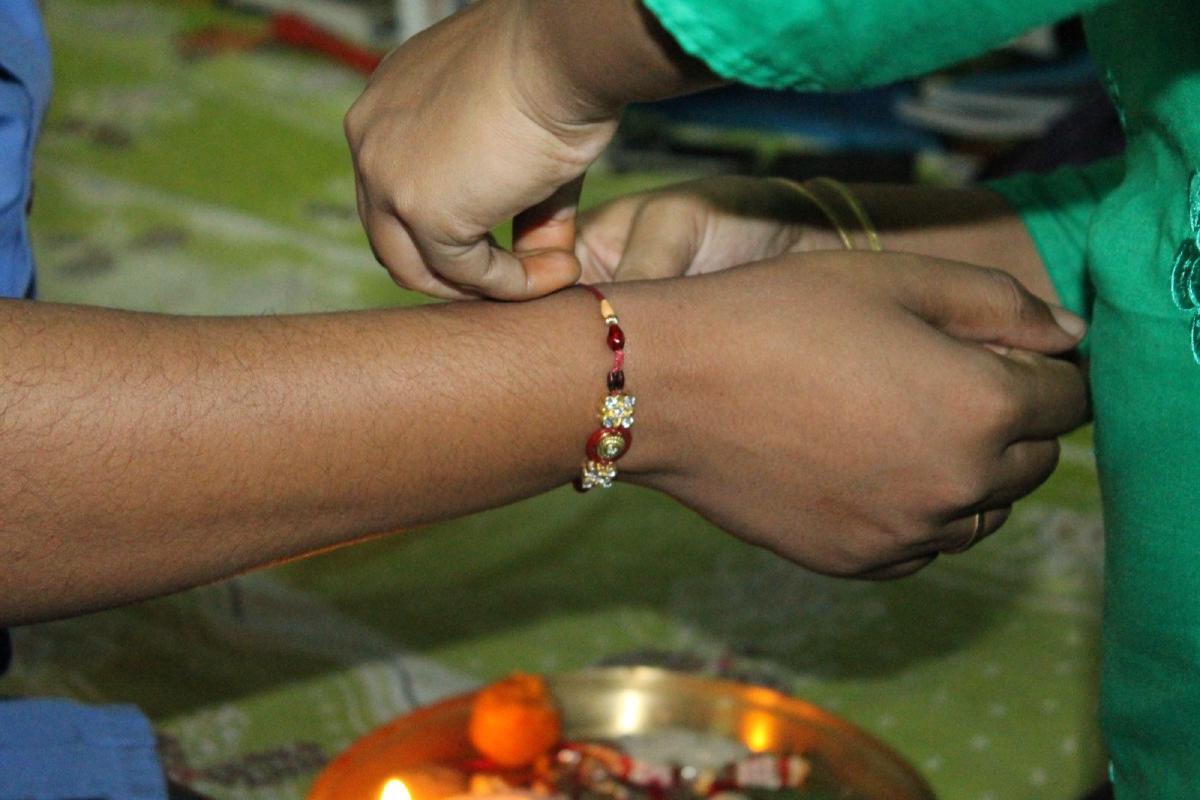
There is a moment on the full moon of Shravana, repeated in millions of homes across Bhārat on the same morning, when a sister takes a coloured thread and ties it around her brother’s wrist. He gives her a gift. She feeds him something sweet. It takes perhaps a minute, and behind that minute stand centuries of stories about gods, queens, poets, and the peculiar strength of a knot that holds nothing together but a promise.
A Thread, a Sweet, and a Promise
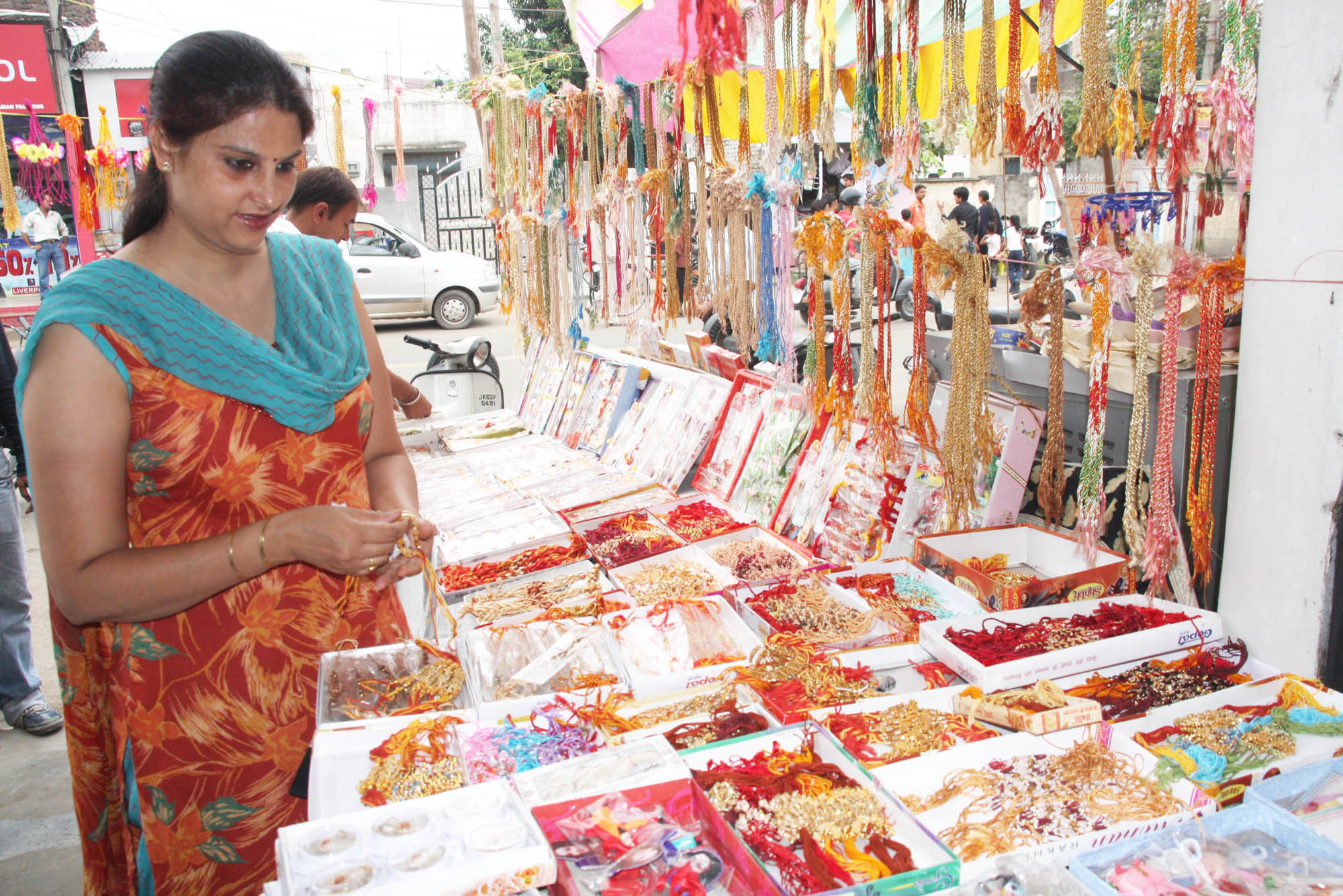
The name says most of it. Raksha Bandhan comes from the Sanskrit raksha, protection, and bandhan, a bond or a tying. The thread itself is the rakhi, from rakshika, a small protective amulet. For weeks before the festival, the markets of north and western Bhārat fill with them, thousands of tiny bright discs of thread and tinsel and mirror-work, strung across shopfronts and heaped in baskets until whole lanes look as though someone has scattered confetti at eye level.

The ritual on the day is small and precise. A plate is prepared with a lamp, a little rice, red powder for the tilak mark on the forehead, a rakhi, and sweets. The sister marks her brother’s forehead, ties the thread on his right wrist, and feeds him. He offers a gift, often money, and with it something older than the gift: an undertaking to stand behind her if she ever needs it. In many families a small prayer is said for his long life while the knot is tightened.


What is easy to miss is that the brother-sister version is the younger of two traditions sharing the same full moon. The older one appears in the Bhavishya Purana, where the family priest, not the sister, ties a protective charm on the wrist of his patron and receives a gift in return. Anthropologists studying villages in Uttar Pradesh in the 1950s found both ceremonies performed side by side, the priestly one and the folk one. Over the twentieth century the folk version won. Factory-made rakhis were light enough to post in an envelope, and a sister who could not travel to her brother could still reach him.
That detail about travel matters more than it sounds. Across much of rural north Bhārat, women traditionally married outside their own village, and custom discouraged their parents from visiting them in their married homes. Raksha Bandhan became the fixed point in the year when married women went back to the village they were born in, sometimes escorted by the very brothers they had come to tie a thread for. The brother was the standing link between a woman’s two households, and the rakhi was the annual renewal of that link.
Krishna, Draupadi, and a Torn Strip of Cloth
The story most often told on this day comes from the Mahabharata. Krishna, in the act of killing his cousin Shishupala with his discus, cut his own finger. Draupadi, seeing the blood, tore a strip from her silk sari without a second thought and bound the wound. Krishna, moved by the gesture, promised to repay her.

.jpg)
The repayment came in the assembly hall at Hastinapura. Draupadi, gambled away by her husbands in a game of dice, was dragged before the court by Dushasana, who set about stripping her in front of the assembled kings while every man in the room looked away. She called out to Krishna. What followed is one of the most famous images in the epic. Her sari became endless. Dushasana pulled and pulled and the cloth kept coming, until he collapsed in exhaustion and the humiliation was defeated by a debt repaid many times over. A strip of cloth for a bleeding finger, answered with cloth without end.
A second story sits behind the older, priestly ritual. The demon king Mahabali had grown so powerful that Vishnu came to him as the dwarf Vamana and asked for as much land as he could cover in three steps. Bali agreed, and Vamana covered the earth and the heavens in two. In one telling, Vishnu then stayed on in Bali’s realm as his gatekeeper, and Lakshmi, wanting her husband back, went to Bali disguised as a woman in distress and tied a thread on his wrist. When he asked what gift she wanted, she asked for Vishnu. The words the priest speaks while tying the charm in the Bhavishya Purana refer to exactly this:
येन बद्धो बली राजा दानवेन्द्रो महाबलः ।
तेन त्वामभिबध्नामि रक्षे मा चल मा चल ॥
With that thread by which Bali, the mighty king of the danavas, was bound, with that very thread I bind you. O protection, do not waver, do not waver.
The last four words are addressed not to the person but to the thread itself, an instruction to an object to stay at its post. Millions of families still speak the line each year as the knot goes on.


The Queen Who Sent a Bracelet
The most repeated historical story attached to Raksha Bandhan is set in 1535. Rani Karnavati, widow of Rana Sanga and regent of Mewar, found Chittor Fort under siege by Bahadur Shah, the Sultan of Gujarat, and understood that her forces could not hold. She is said to have sent a rakhi to the Mughal emperor Humayun, asking him, as a brother, for help. Humayun set out. He arrived too late. Chittor had fallen, and Karnavati had died.


It is a wonderful story and it is very probably not true. No contemporary source mentions it, not the Mughal chroniclers of Humayun’s own court and not Humayun’s memoirs, which give quite different reasons for his campaign against Bahadur Shah. The rakhi appears for the first time in a Rajasthani account written more than a hundred years later. The historian Satish Chandra put it plainly: since none of the contemporary sources mention it, little credit can be given to the story.
A second popular legend is even easier to date. Alexander’s wife Roxana is said to have tied a rakhi on the arm of King Porus, who then spared Alexander’s life in single combat. The episode is retold constantly as ancient evidence for the festival’s antiquity. In fact it seems to have been invented for the 1941 Hindi film Sikandar, and scholars looking for any earlier version of it have come up empty-handed. Both tales tell us less about the sixteenth century or the fourth century BCE than about the twentieth, and about how badly a festival of protective bonds wanted a history of protective bonds.
Tagore’s Rakhi, October 1905
The one episode that is thoroughly documented is also the most remarkable. On 16 October 1905, the partition of Bengal took effect, splitting the province along a line that separated a largely Muslim east from a largely Hindu west. Lord Curzon called it administrative efficiency. Bengal read it as an attempt to divide her.


That day happened to be Raksha Bandhan. Rabindranath Tagore seized on the coincidence and turned the festival into a protest. He called on Bengalis to go into the streets and tie rakhis on one another, Hindu on Muslim and Muslim on Hindu, as a public declaration that the province would not consent to being cut in half. Processions moved through Calcutta with people stopping strangers to tie threads on their wrists. It was one of the opening acts of the Swadeshi movement, and the partition was undone six years later. In that single morning, a small domestic ritual became a political argument, which is perhaps the clearest evidence of how much weight a thread can carry.
That elasticity has stayed with the festival. Rakhis are tied between people who are not related at all, creating voluntary kinship that has crossed lines of caste, class, and religion. They are tied on soldiers, on doctors, on presidents and prime ministers by visiting schoolchildren. Sisters tie them on sisters. In much of the country the thread has quietly stopped being about a brother’s protection and started being about a relationship worth naming.
One Moon, Many Festivals
The full moon of Shravana is a busy one, and Raksha Bandhan is only the best known of the things that happen on it. Along the Konkan coast of Maharashtra, the Koli fishing community observes Narali Purnima, coconut full moon. The monsoon has kept the boats ashore for weeks, and this is the day the sea is formally asked for permission to return. Coconuts are thrown into the water as offerings to Varuna, the god of the ocean, the boats are repainted and garlanded, and the fishing season opens the next morning.


In Tamil Nadu, Kerala, Karnataka, and Andhra Pradesh, the same day is Upakarma, known as Avani Avittam in the south, when the sacred thread worn across the chest is ceremonially replaced and Vedic study for the year formally begins. In Nepal it is Janai Purnima, built around the same thread-changing rite and observed by Hindus and Buddhists alike. In Odisha it is Gamha Purnima, the birthday of Balarama, god of farming and the elder brother of Krishna, and farmers there tie rakhis on their cattle.


In West Bengal the day closes Jhulan Purnima, the swing festival, when images of Radha and Krishna are placed on decorated swings in temples and courtyards and rocked gently for days to the sound of singing. Swings are the signature of Shravana everywhere. The month falls in the middle of the monsoon, the fields are green, the trees are heavy with water, and across the northern plains women hang ropes from branches and sing kajari, the rain songs of the Bhojpuri country, about absence and return and the long wait for someone who has gone away.
It is worth sitting for a moment with what the rakhi actually is. It is a piece of thread. It costs almost nothing, it frays within a fortnight, and it prevents precisely nothing. And yet Bhārat has spent a very long time investing it with the idea that a bond, publicly declared, is itself a form of protection. Draupadi’s torn sari, the priest’s charm on a king’s wrist, a queen’s desperate message across enemy lines, a poet turning a festival into a protest on the morning a province was cut in two. All of it comes back to the same simple act of tying something around someone else’s arm and saying, out loud, that you are answerable for them.
This year, Raksha Bandhan falls on 28 August. The monsoon will still be over most of the country, the trains and buses will be full of women travelling home, and by mid-morning several hundred million wrists will be wearing a bright thread that will not survive the month. That is rather the point. The thread is not meant to last. The promise is.
