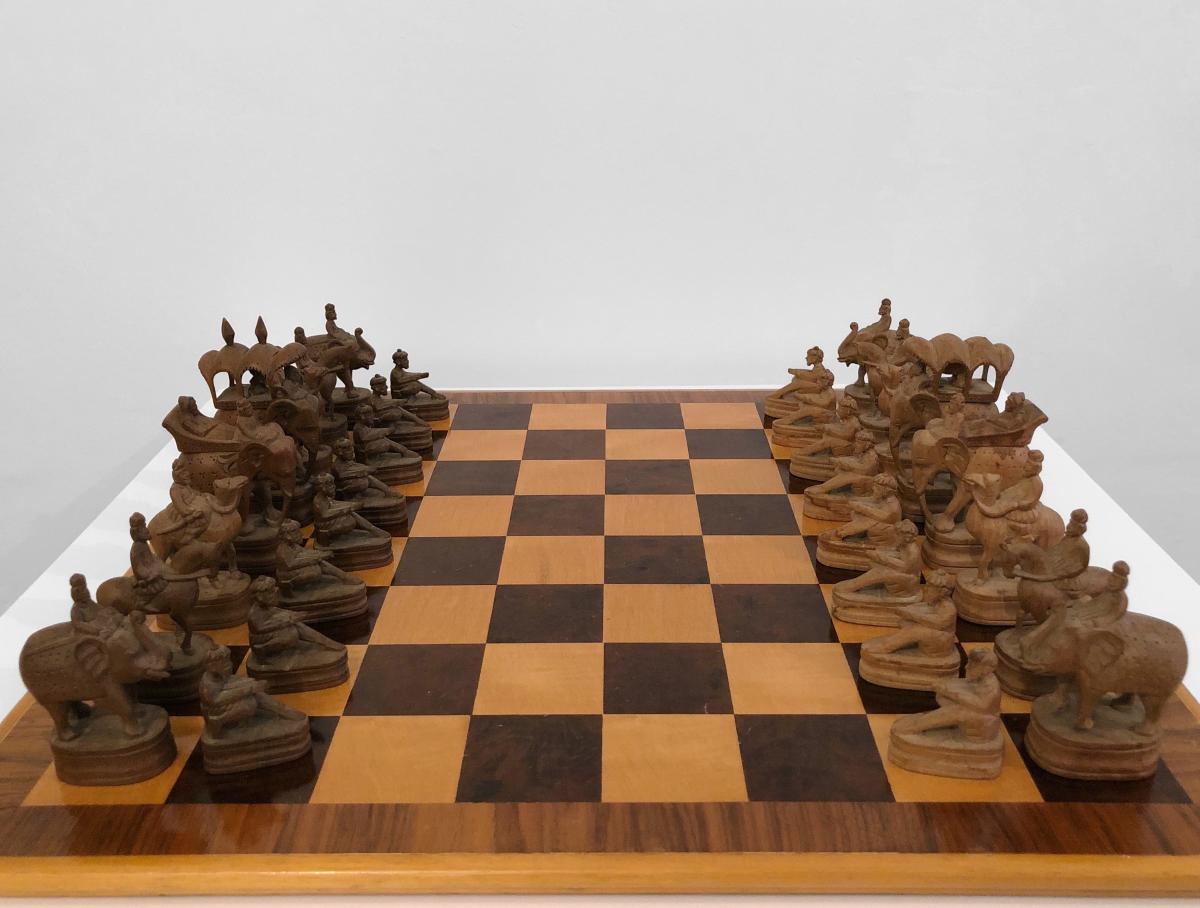
As we write this, eight of the world’s greatest chess players are locked in battle at a resort in Pegeia, Cyprus, for the right to challenge Gukesh Dommaraju, the reigning World Chess Champion. The 2026 FIDE Candidates Tournament is midway through its fourteen rounds, and already producing the kind of drama that makes the game irresistible. But few of the spectators watching online will pause to consider that this game, this ancient contest of kings and strategy, was born in Bhārat, perhaps as many as 1,500 years ago, in the courts of the Gupta Empire.
Chaturanga: A Battlefield on a Board
The earliest known ancestor of chess is called chaturanga, a Sanskrit word meaning “four divisions.” It referred to the four branches of the ancient Indian military: infantry, cavalry, chariots, and elephants, each represented by a piece on the board. At the center of it all stood the rāja, the king, the one piece whose capture decided everything. This was not just a game of strategy, it was a miniature battlefield, designed to simulate the art of war.
The game was likely played on an 8×8 grid called aṣṭāpada, a board that had been used for other racing and dice games even earlier. What made chaturanga different was the idea that each piece moved differently, according to its nature on the battlefield. The elephant (hasti) moved powerfully but in restricted ways. The chariot (ratha) swept across the board in straight lines. The cavalry could leap over other pieces. Infantry moved one step at a time, like foot soldiers in the dust. The design was almost poetic in its logic.
Early versions may even have been played by four players simultaneously, one commanding each military division, with dice determining which piece could move. Over time, the game shed the dice and the extra players, and settled into the tense, cerebral two-player duel we know today. That transition, from a game of chance to a game of pure thought, was itself a remarkable evolution.
Chaturanga appears in texts and references from around the 6th century CE, during the reign of the Guptas, a dynasty that also produced extraordinary advances in mathematics, astronomy, literature, and philosophy. The Guptas presided over what many historians call a golden age of ancient Bhārat, and chess was one of its gifts to the world.
From Bhārat to Persia

The path from chaturanga to modern chess passed first through Persia. Persian texts from the 6th and 7th centuries CE describe the game arriving from Bhārat and being greeted with great enthusiasm at the Sassanid court of Khosrow I. One famous Persian text, the Wizārišn ī Čatrang ud Nihišn ī Nēw-Ardaxšīr (“On the Explanation of Chess and the Invention of Backgammon”), tells the story of an Indian ambassador arriving with the game as a kind of intellectual challenge. The Persians were expected to deduce the rules of the game simply by observing the pieces. When they succeeded, they sent back a puzzle of their own: the game of backgammon. Whether or not the story is historical, it captures the spirit of intellectual exchange that chess represented.
In Persia the game was called chatrang and later shatranj, adaptations of the Sanskrit chaturanga. Persian players refined the game’s rules and wrote the earliest known manuals on chess strategy. The rāja became the shāh, which is where we get the word “check.” The phrase “checkmate” comes from the Persian shāh māt, meaning “the king is helpless” or “the king is dead.”
Across the Islamic World and Into Europe
After the Arab conquest of Persia in the 7th century CE, shatranj spread rapidly across the vast Islamic Caliphate, from Central Asia to the shores of the Atlantic. Arab scholars wrote extensively about chess theory, and the game became a pastime of caliphs, poets, and philosophers. Al-Adli, a 9th-century Baghdad player, is sometimes credited with writing the first comprehensive book on chess strategy.
Chess entered Europe through two main routes: via Moorish Spain in the west, and through Sicily and southern Italy in the east. By the 10th and 11th centuries, the game had taken root across the continent. The famous Lewis chessmen, carved from walrus ivory and discovered on a Scottish island, date to the 12th century and already show pieces that look strikingly familiar: kings, queens, bishops, knights, rooks.
As chess traveled through these different cultures, it transformed. The chariot became the rook, a word derived from the Arabic rukh. The elephant became the bishop: Europeans who had never seen an elephant encountered abstract Islamic chess pieces and interpreted the notched top as a bishop’s mitre. And the powerful Indian minister, the mantri, was transformed into the queen, who by the 15th century had become the most powerful piece on the board. Yet the heart of the game, the logic, the grid, the objective of capturing the king, remained unchanged from what was first imagined in ancient Bhārat. The English word “chess” itself traces back through Old French esches and Arabic al-shatranj to the Sanskrit chaturanga.
A Champion’s Legacy
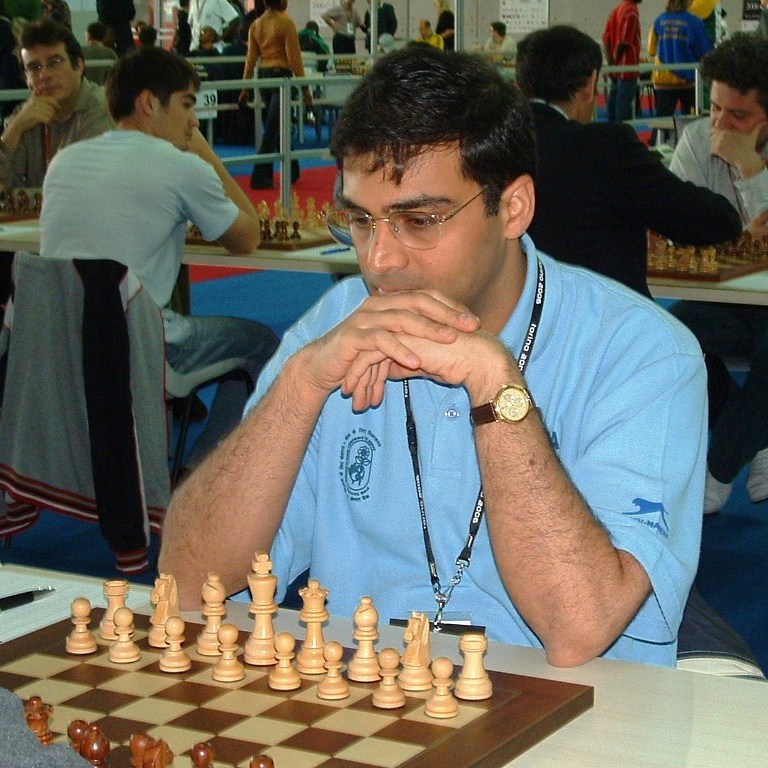
The story of chess and Bhārat does not end in the ancient past. For much of the 20th century, world chess was dominated by Soviet players, who treated the game as a matter of national prestige and trained grandmasters with almost scientific intensity. It was against this backdrop that Viswanathan Anand emerged from Chennai in the 1980s and 90s to become one of the game’s all-time greats.
Anand first became World Chess Champion in 2000 and went on to win the title five times in total, a record matched by very few players in the game’s history. His style was famously quick and intuitive, calculating at speeds that left opponents and commentators alike struggling to keep up. He became the first Asian player to be ranked world number one. For millions of young Indians who grew up watching him, he made the game feel like something that belonged to them, not just to Europe or the Soviet world.
Bhārat’s chess infrastructure grew around Anand’s example. Academies, coaches, and tournaments multiplied. The number of Indian grandmasters climbed steadily, then rapidly. By the early 2020s, Bhārat had well over 80 grandmasters, placing it among the top countries in the world for elite chess talent.
The New Generation

.jpg)
Anand’s inspiration has now produced a worthy successor. In December 2024, Gukesh Dommaraju, an 18-year-old from Chennai, became the youngest World Chess Champion in history, defeating the reigning champion Ding Liren in a tense and dramatic final match in Singapore. Gukesh is only the second Indian World Champion, following Anand, and his victory felt like history completing a circle: the land that invented the game now producing its greatest player.
What makes Gukesh’s achievement even more remarkable is the company he keeps. Chennai alone has produced an extraordinary cluster of chess prodigies. R. Praggnanandhaa, who became the world’s youngest International Master at ten years and ten months, and a Grandmaster at twelve, is considered by many to be one of the most naturally gifted players of his generation. Arjun Erigaisi has risen to the top ten in world rankings. And at the 2024 Chess Olympiad in Budapest, Bhārat won both the open and women’s gold medals on the same day, a historic double that sent the country into celebration.
The World Comes to Play
The early rounds of the 2026 Candidates Tournament in Cyprus have been electrifying. A 20-year-old Uzbek debutant, Javokhir Sindarov, has stormed to a commanding lead, defeating the two highest-rated players in the field back to back. Among those chasing him is Praggnanandhaa himself, still only 20 years old, who faces Sindarov directly in an upcoming round. A Praggnanandhaa win could reshape the tournament entirely, and perhaps set up a world championship match between two players who were barely teenagers when Gukesh first burst onto the world scene.
The tournament draws millions of viewers online, following the moves in real time on apps and streaming platforms, debating plans in comments and forums in dozens of languages. This is what chess has become: a truly global game, watched and played on every continent. And all of it traces back to a board game imagined in ancient Bhārat, in the courts of an empire that had already given the world the concept of zero, the decimal system, and some of the most enduring literature ever written.
From the courts of the Gupta emperors to the global stage of the World Chess Championship, chess has carried a piece of Bhārat with it across fifteen centuries and every continent. It began as a way of understanding war and the movement of armies, and became something far greater: a universal language of the mind, one that Bhārat first taught the world to speak. That the world’s current champion comes from Chennai, the same city that produced Viswanathan Anand, feels less like coincidence and more like continuity, a thread running unbroken from an ancient 8×8 grid to a tournament hall in Cyprus, where the next chapter of the game’s long story is still being written.