As we write this, eight of the world’s greatest chess players are locked in battle at a resort in Pegeia, Cyprus, for the right to challenge Gukesh Dommaraju, the reigning World Chess Champion. The 2026 FIDE Candidates Tournament is midway through its fourteen rounds, and already producing the kind of drama that makes the game irresistible. But few of the spectators watching online will pause to consider that this game, this ancient contest of kings and strategy, was born in Bhārat, perhaps as many as 1,500 years ago, in the courts of the Gupta Empire.
Chaturanga: A Battlefield on a Board 🔗


The earliest known ancestor of chess is called chaturanga, a Sanskrit word meaning “four divisions.” It referred to the four branches of the ancient Indian military: infantry, cavalry, chariots, and elephants, each represented by a piece on the board. At the center of it all stood the rāja, the king, the one piece whose capture decided everything. This was not just a game of strategy, it was a miniature battlefield, designed to simulate the art of war. Early versions may even have been played by four players, one commanding each division, before the game settled into the two-player form we know today.
Chaturanga appears in texts and references from around the 6th century CE, during the reign of the Guptas, a dynasty that also produced extraordinary advances in mathematics, astronomy, and literature. The game was likely played on an 8×8 grid called aṣṭāpada, which had been used for other board games even earlier. From this fertile ground, the game began its long journey across the world.
From Bhārat to the World 🔗

The path from chaturanga to modern chess passed through Persia, where the game was called chatrang and later shatranj. Persian texts from the 6th and 7th centuries CE describe the game arriving from Bhārat and being embraced with great enthusiasm at the Sassanid court. When Arab armies conquered Persia in the 7th century, they took the game with them, spreading it across the Islamic world and eventually into Europe through Spain and Sicily.
As chess traveled, it transformed. The chariot became the rook, the elephant became the bishop, and the powerful minister (the mantri) became the queen. Yet the heart of the game, the logic, the grid, the objective of capturing the king, remained unchanged from what was imagined in ancient Bhārat. The English word “chess” itself traces back through Old French and Arabic to the Sanskrit root.
A Champion’s Legacy 🔗
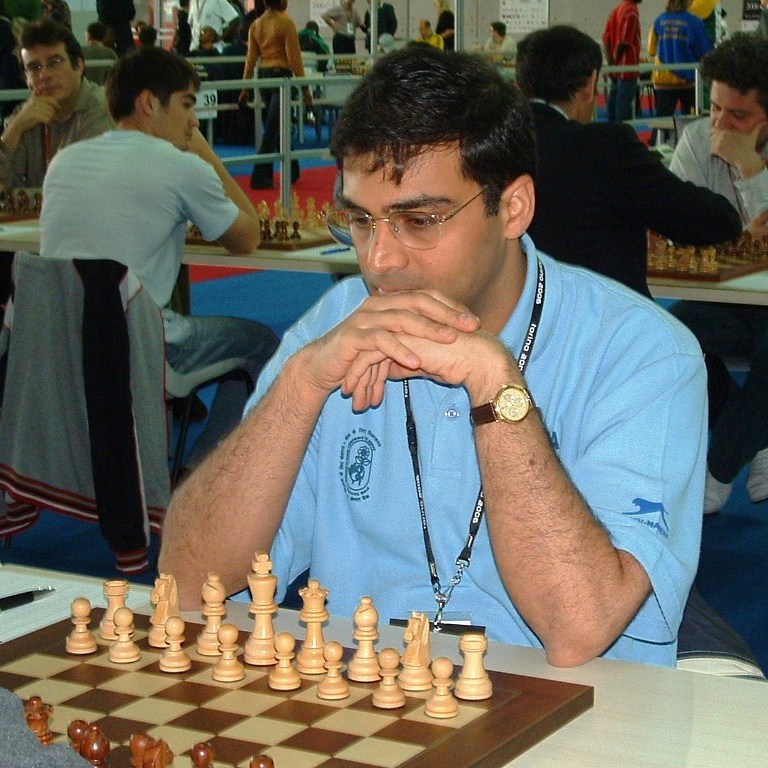
The story of chess and Bhārat does not end in the ancient past. Today, Bhārat is one of the dominant forces in world chess, home to more grandmasters than almost any other country. At the peak of this tradition stands Viswanathan Anand, who first became World Chess Champion in 2000 and went on to win the title five times. His fluid, intuitive style inspired a generation of young players.

.jpg)
That inspiration has now produced a worthy successor. In 2024, Gukesh Dommaraju, a 18-year-old from Chennai, became the youngest World Chess Champion in history, defeating the reigning champion Ding Liren. Gukesh is only the second World Champion from Bhārat, and his victory felt like history completing a circle: the land that invented the game now producing the greatest player in the world.
The World Comes to Play 🔗
The early rounds in Cyprus have been electrifying. A 20-year-old Uzbek debutant, Javokhir Sindarov, has stormed to a commanding lead, defeating the two highest-rated players in the field back to back. Among those chasing him is R. Praggnanandhaa, another young Indian grandmaster from Chennai, who faces Sindarov directly in the next round. A win for Praggnanandhaa could reshape the tournament entirely, and perhaps set up a world championship match between two players from the land that invented the game.
From the courts of the Gupta emperors to the global stage of the World Chess Championship, chess has carried a piece of Bhārat with it across fifteen centuries and every continent. It began as a way of understanding war and strategy, and became something far greater: a universal language of the mind, one that Bhārat first taught the world to speak.